
Making sense of organisations with AI


Agentic Enterprise, Frontier Firm, Agentic Organization, hybrid organisation: we also find these terms difficult to tell apart. We encounter them in vendors’ publications and use them ourselves as we integrate autonomous AI agents into our clients’ teams and build hybrid organisations. It is often unclear whether a new name also describes a different idea of work.
That is why we read the original texts more closely and examined their language. The four terms describe related changes. Their meanings overlap, while their authors emphasise different aspects. These texts offer only limited support for anyone looking for a clear boundary.
We bring our own perspective: at MING, we speak of the hybrid organisation to describe our approach to work with people and agents. Here we explain why we use that term, how we understand the other approaches and what we consider unresolved. This interpretation is intended to establish a shared basis for discussion.
The four terms can describe the same company from different perspectives.
The terms share a common core
In the texts we examined, AI increasingly takes on work within the company. Autonomous agents carry out tasks in several steps, access knowledge and act in connected systems.
The organisational questions begin when someone has to integrate that work: which area of responsibility belongs to the agent, and who does it report to? What information does it receive? What may it decide, who checks the result and who takes over an unclear case? These questions appear with different emphases at Salesforce, IBM, Microsoft and McKinsey, and in our own approach.
People and autonomous AI agents together change what work a company can accomplish. This ranges from supporting individual activities to taking on ongoing responsibilities, independently carrying out entire functions and coordinating across departments. People lead the agents and remain accountable for the results. The name alone does not reveal how far a company has progressed.
Vendors emphasise different aspects
We compare how the named companies use these terms. The overview shows our interpretation of their emphases. Each term is then explained with a link to the original source.
| Term and source | The question the text develops in particular depth |
|---|---|
| Agentic EnterpriseSalesforce and IBM | How do agents perform work in our business systems? |
| Frontier FirmMicrosoft | Which work do people do themselves, and which do they delegate to AI? |
| Agentic OrganizationMcKinsey | How do the business model, leadership and responsibilities change? |
| Hybrid organisationMING Labs | How do people and autonomous agents work together with clear roles and accountability? |
Agentic Enterprise connects agents with business operations
At Salesforce and IBM, Agentic Enterprise describes a company in which people and AI agents work together in business operations. “Agentic” refers to AI’s ability to perform tasks and take actions.
Salesforce emphasises the connection between people, agents and platforms. Shared information, defined authority and traceable decisions are intended to support this collaboration. IBM describes the integration of agents across business functions, including planning, memory, tools and oversight. Human accountability is part of both accounts. Salesforce[S1], IBM[S2]
Our reading: the central question here is how autonomous agents become part of connected, reliably governed business operations. This is close to our own approach to the hybrid organisation. We also connect agents with roles, company knowledge, business systems and human leadership. That proximity makes a sharp distinction difficult. Even Salesforce and IBM develop the same term differently.
Frontier Firm redistributes work between people and AI
Frontier Firm is Microsoft’s term for companies that redesign work around collaboration between people and agents. “Frontier” signals an ambition to lead this development.
Microsoft focuses on which form of human participation suits each type of work: doing the work with AI support, editing an AI draft, delegating a complete task or coordinating several agents. In its May 2026 text, Microsoft explicitly states that not every task should move towards the most extensive form of delegation. Microsoft[S3]
Our reading: the term helps connect the design of work with available capacity. Leaders must decide where people remain directly involved and where they set goals, check results or handle exceptions.
Agentic Organization also changes leadership and responsibilities
At McKinsey, Agentic Organization describes an organisation in which people and agents create value together, requiring substantial parts of the company to be redesigned. The text considers the business model, the organisation of work, governance, people and culture, and technology and data together.
McKinsey describes small, cross-functional teams that are accountable for an outcome and lead the associated agent work. Its approach therefore also addresses decision rights, leadership and employees’ skills. McKinsey[S4]
Our reading: this account develops in particular depth what must change within a company as agents take on larger portions of work. Its vision covers the company as a whole; implementation can begin in individual areas.
The hybrid organisation expands what a company can do
At MING, a hybrid organisation is a company in which people and autonomous AI agents work together with defined tasks, authority and human accountability for results.
We deliberately speak of a hybrid organisation because we put people and their collaboration with autonomous agents at the centre.
Our starting point is the people in the company: their experience, their accountability and the work they want to accomplish. Agents take on ongoing responsibilities through to entire functions. Teams can then do more, serve customers better and pursue new business opportunities. People set the goals and boundaries and remain accountable for results. This is MING’s approach to the Agentic Enterprise.
We build agents, connect them to existing systems and onboard them with the client team. Each role receives a job description, a reporting line and clearly agreed authority. We design leadership, approvals and collaboration alongside the technical foundation. In our implementation, an agent harness brings together execution, tools, permissions and controls. Connectors link them to business systems. A Company Brain provides verified company knowledge and the context of work in progress. These elements turn a language model into an agent that can work within a company. Agents can work around the clock and in parallel, providing teams with additional capacity. MING: The hybrid organisation[S5]
The business benefit has two sides: delivering existing work with less total effort and making additional work economically viable. This can mean serving more customers, preparing proposals faster or systematically pursuing opportunities for which capacity was previously lacking. This can change costs, service and growth opportunities. Shared knowledge and reusable capabilities support expansion from the first team to entire functions and collaboration across departments.
Overlap is part of the picture
A company can fit several of these descriptions at once. Agents in business operations, redesigned work, changed responsibilities and a shared technical foundation are compatible. Collaboration and human accountability are not exclusive to any one term either.
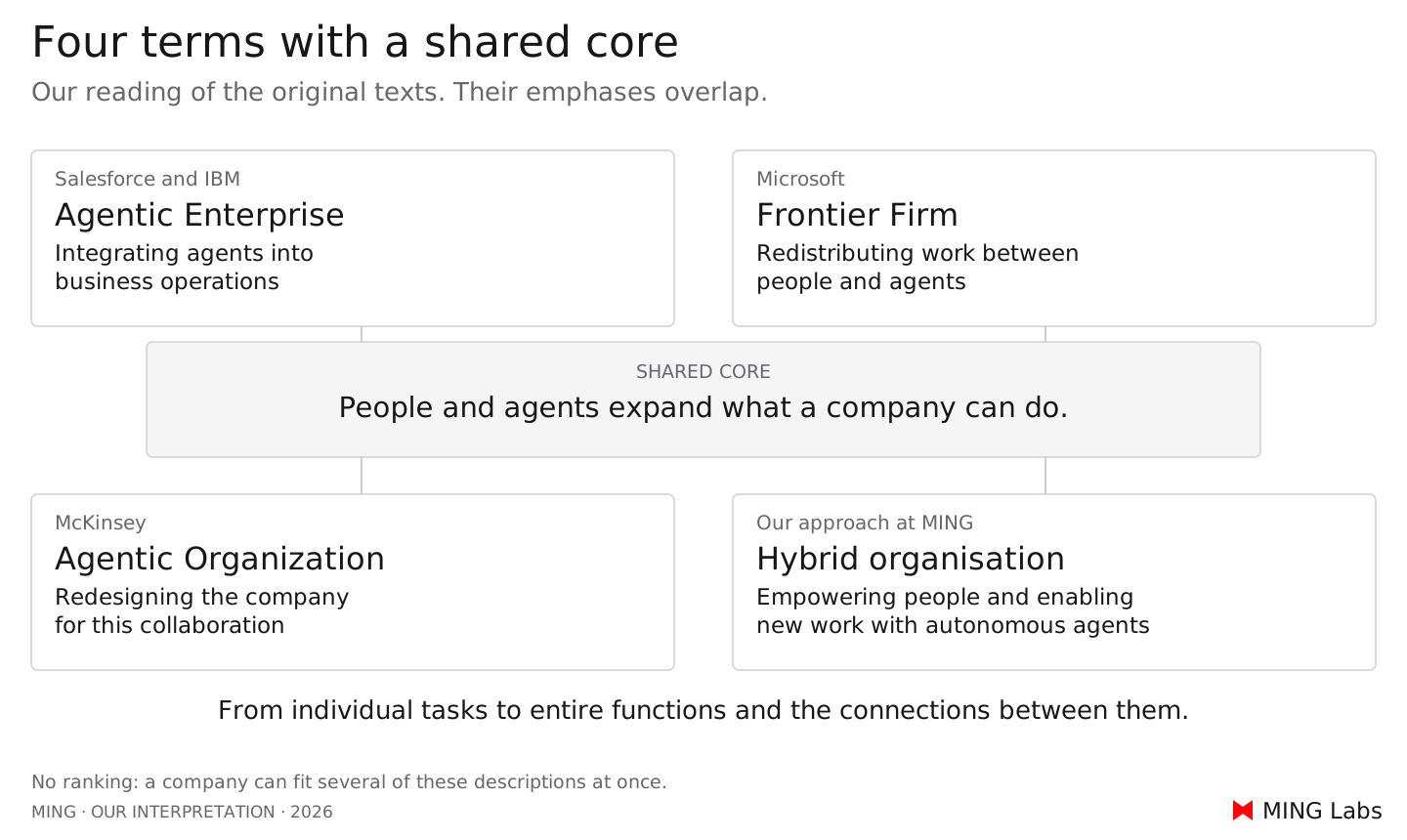
We also read all four accounts as statements of their authors’ positions, including our own text. The emphases described do not constitute a complete assessment of a company’s services.
We therefore distinguish between a name, a provider’s explanation of it and the actual setup within a company. “Enterprise” versus “Organization”, for example, does not establish a reliable conceptual boundary on its own. In a conversation, it helps to ask which work, decisions and technical requirements are being discussed.
MING integrates agents into your teams
We start where limited capacity, high costs or slow processes constrain the business. With leaders, we define the intended business effect. With the team, we examine actual work and job descriptions to determine which tasks people retain, which they share with agents and which agents take on autonomously. This produces clear roles for both and the technical foundation for their collaboration.
At STREIT, the agent Tabea prepares order proposals from emails[S6]; people retain control and handle unclear cases. This makes a bounded division of work tangible. On its own, it is not evidence that an entire company already operates differently.
Our measure is the business effect after all costs of setup, operation, oversight and rework. For existing work, we compare measures such as cost per correctly completed case, turnaround time and available capacity. For additional work, we examine the value of the new service: which customers can be served better, which additional proposals can be prepared, which opportunities can be pursued? We use the term latent work for valuable work that was previously left undone or uneconomic. Agents can take it on directly; it need not wait for people to gain spare time.
Agents can make work economically viable where capacity was previously lacking.
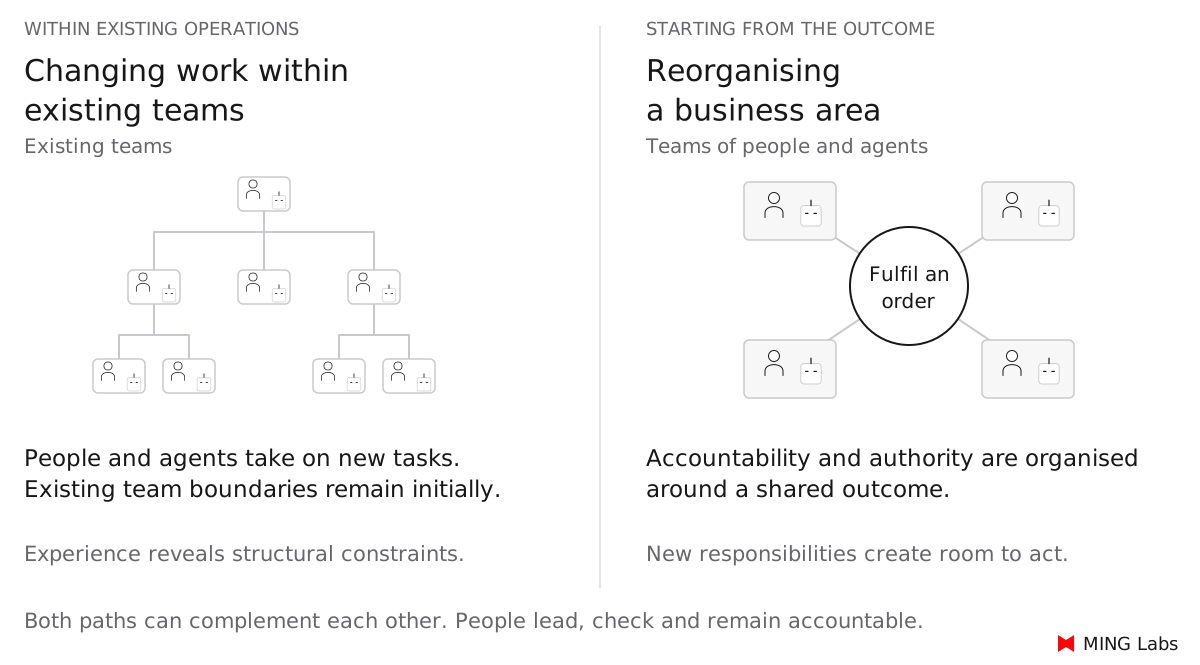
Each agent role receives a job description: ongoing tasks, expected results, decision rights, a reporting line and rules for exceptions. The agent works through the team’s familiar channels and can handle routine work outside human working hours. Availability around the clock still requires leadership: approvals, escalations and technical support remain organised. As reliability improves, the accountable person can extend the agent’s scope of action.
What works should help other teams. The Company Brain keeps confirmed knowledge and ongoing cases accessible. Connectors provide permitted system access; the harness governs execution and its controls. Further agents and teams can then build on a common foundation instead of developing the same integrations and working rules again.
That foundation must persist between individual executions. We use the technical term persistence: an open customer question remains visible, a confirmed requirement still applies and a price limit is respected at the next step. The information must remain current and attached to the correct case.
Team experience also exposes limits. If a decision gets stuck between departments, responsibility must be assigned for the complete process. Adding another agent role alone does not solve that problem. This is where practical work and organisational design meet.
Four stages of the hybrid organisation
The following overview shows our four stages of development towards the hybrid organisation: from AI support for one person to permanent agent roles, entire functions and collaboration across departments. Each stage covers a larger portion of work. This is MING’s interpretation, not an industry-standard maturity model. The four terms in the comparison are not names for these stages.
At STREIT, Tabea makes the transition to a permanent agent role tangible: the agent prepares orders and people handle unclear cases. For the next two stages, we use examples from our own work at MING and our venture Hyperize, which helps brands become discoverable in AI answers. They describe our working practices, not a complete transformation demonstrated at STREIT or a measured revenue effect.
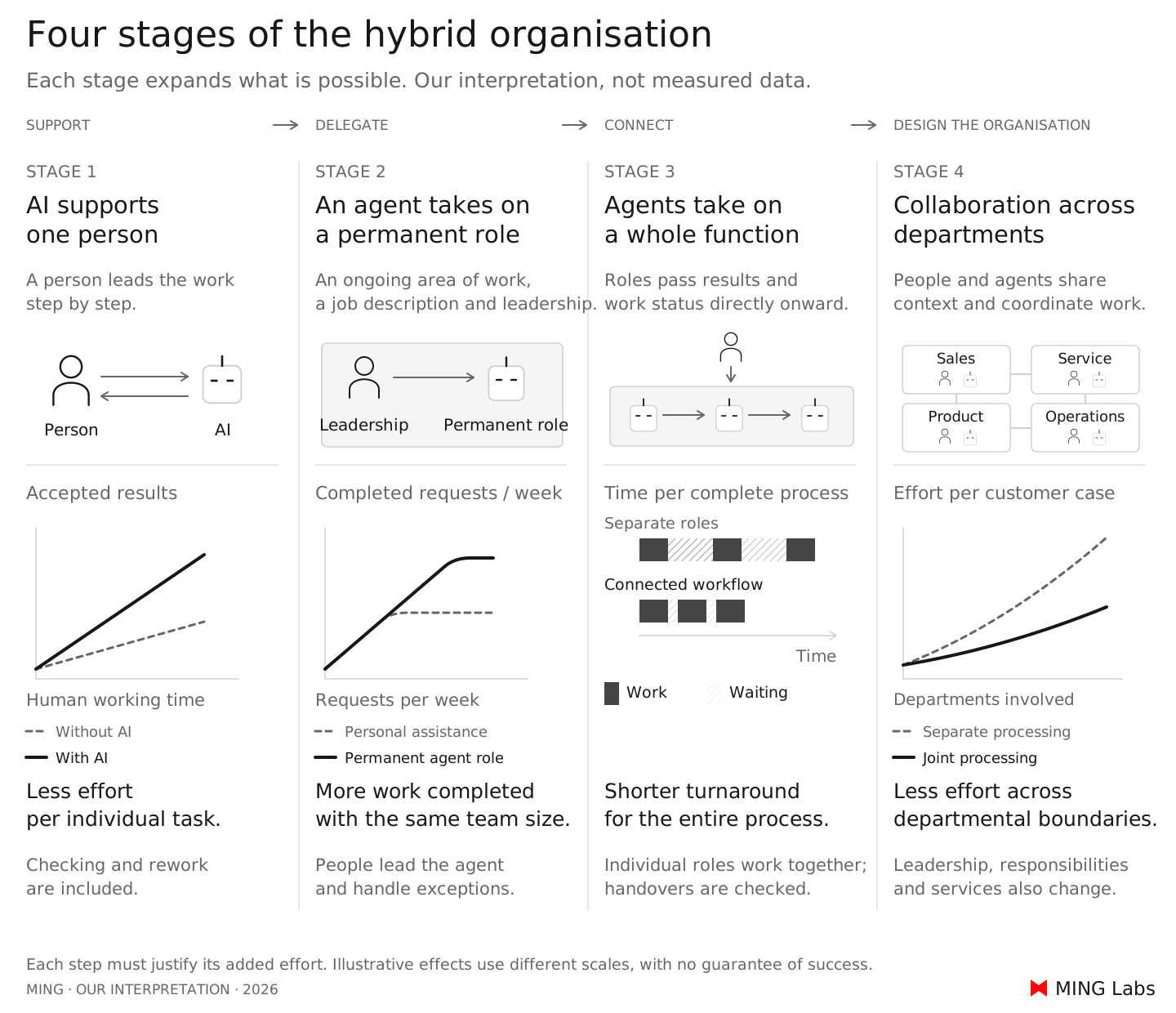
Stage 1: A person works with AI. The person leads the task step by step, using AI to prepare a draft, for example. The first benefit is less effort per usable result, including checking and rework.
A permanent agent role owns an area of work and does not wait for the next prompt.
Stage 2: An agent takes on a permanent role in the team. Its job description defines a recurring area of responsibility, such as preparing each incoming order or regularly checking new tenders. Goals, reporting lines, authority and exceptions are agreed. The team gains capacity because the agent handles its area of work autonomously, including when the person leading it is not present.
Stage 3: Agents take on processes within a function or the entire function. One internal example is our website work at MING and Hyperize, including search engine optimisation (SEO) and visibility in AI answers (GEO). Agents research customer questions, analyse search and usage data, develop content and improve the website. Other agents check the results and subsequently observe how pages are found, used and cited in AI answers. These findings feed into the next revision. This creates a recurring workflow, a loop, covering the function from research through follow-up measurement. Schedules initiate the recurring steps, and agents carry them out autonomously. People set goals, decide priorities and handle agreed approvals. Research, implementation and follow-up measurement form a continuous process in which knowledge is retained between steps.[S11]
Stage 4: People and agents work together across departments. In our work, this connects marketing and sales. The website and its content generate customer enquiries. Agents use the available information to prepare a suitable presentation for the conversation. People conduct the customer call; agents then use the transcript to turn requirements, open questions and next steps into a proposal draft. People decide the scope, price and commitments. What we learn from these conversations feeds back into content and the website. Stage 3 connects work within a function; stage 4 connects work across departments. Marketing and sales continue with the same customer context, from initial interest to proposal. Our aim is to lose less knowledge at handovers and to start the next step from the progress already made.[S11]
The stages build on each other in scope. The next step makes sense when it removes another constraint and its additional benefit justifies setup and operation. A larger system does not automatically deliver a larger gain. Earlier stages remain useful for suitable tasks. The effects illustrated are examples of benefits, not exclusive properties of a particular stage.
For unusual tasks, a changing group of agents can be useful within a process: different contributions are assembled for a goal and adjusted along the way. Here we call such a group an agent swarm. For similar, recurring cases, a defined workflow often requires less coordination.
Reuse can build an advantage
Long-term value arises when an improvement helps again in the next deployment. A confirmed requirement, a checked workflow or a proven test then need not be developed from scratch. The next deployment starts with a better foundation and can contribute something in turn.
Suppose a team handling orders identifies a recurring gap in delivery information. It improves the follow-up question, tests it on comparable cases and incorporates it into the workflow. If other teams can reuse this verified solution, the same improvement has an effect in several places. Experience from those deployments can then help refine it further. This illustrates the mechanism; it is not a measured result from the STREIT project.
When teams reuse verified improvements, each team does not have to start from scratch.
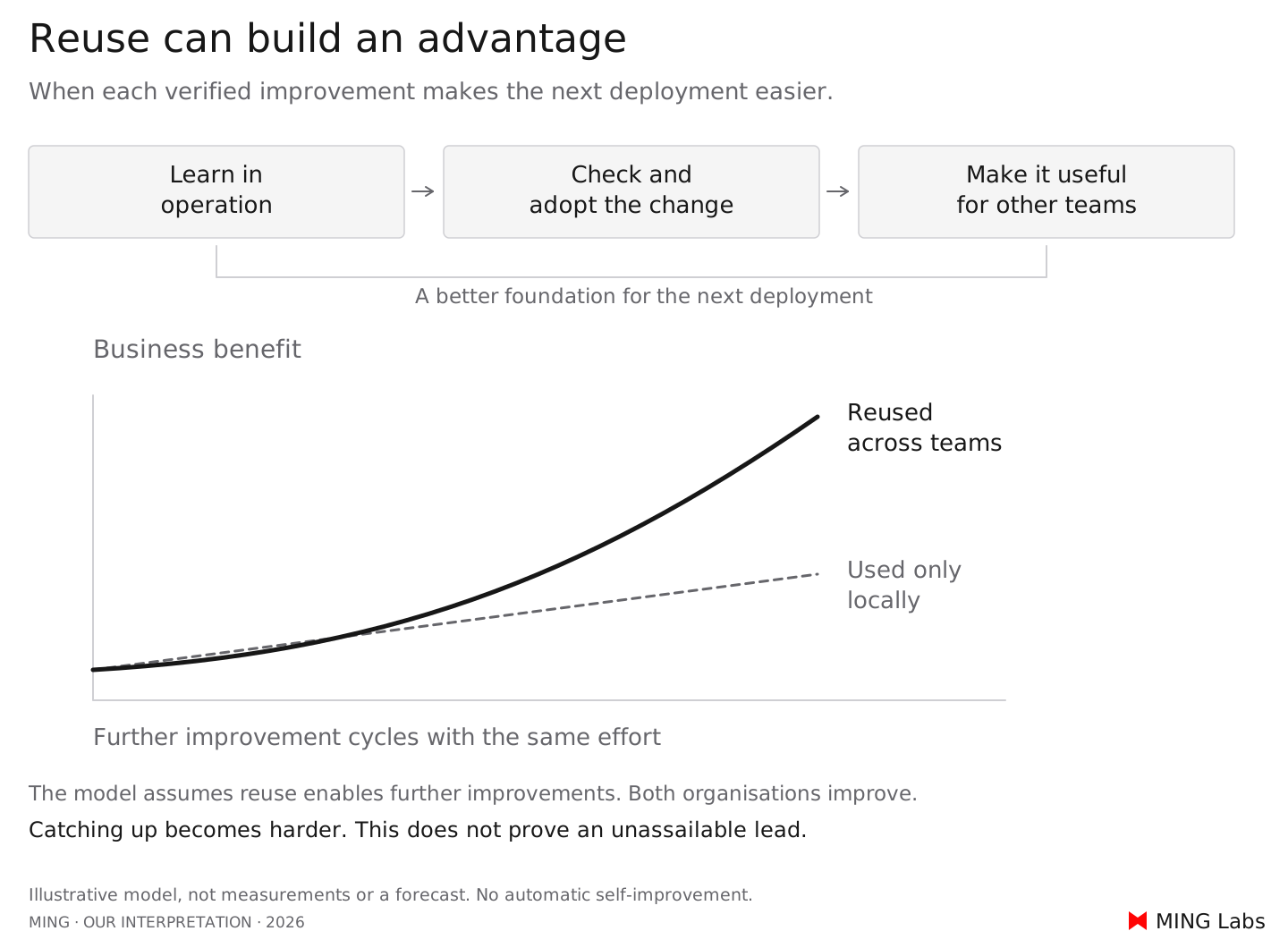
This is what we mean by a compounding improvement advantage: knowledge and proven capabilities are retained, become useful in more places and enable further improvements. They include confirmed domain knowledge, permitted system access, functioning workflows and tests. Time gained must also be invested in better work or further improvements. Storage alone does not create this effect.
Companies that start later need suitable operational experience and capabilities as well as the tools. Building or acquiring them can make catching up harder. Microsoft describes a similar ambition: organisations should learn faster and build capabilities with every cycle. This is a strategic expectation, not evidence of an unassailable lead. Microsoft[S3]
How durable a lead is depends on how easily others can replicate or replace those capabilities. New tools, staff changes and better practices alter these conditions. AI can also help others catch up: a customer-support study found larger productivity gains among less experienced workers. That does not establish an effect at company level, but it does challenge a blanket claim that a lead cannot be overcome. Dierickx and Cool[S7], Brynjolfsson, Li and Raymond[S8]
For our work, this means checking improvements against quality and total effort and assessing their reuse. Not every attempt succeeds; outdated knowledge must be corrected. People remain accountable for adopting changes. Research into systems that modify their own program code goes further. Such recursive self-improvement is not a requirement for the advantage described here. Sakana AI[S9]
Our interpretation can be checked against the sources
Our interpretation rests on selected original texts and their specific claims. Search data provides additional context about the names people search for. Word counts reveal linguistic emphases and suggest questions for a closer reading. The data does not measure the quality of organisational forms.[S10]
The following data graphics are shown in full. They document the research behind this comparison; a term’s meaning comes from the statements in their context.
Which terms people search for
The search map compares selected queries in Germany. Monthly estimates come from Google Ads, while the number of weeks with a signal comes from Google Trends. These are different measures. They establish neither the prevalence of a way of working nor a growth rate.
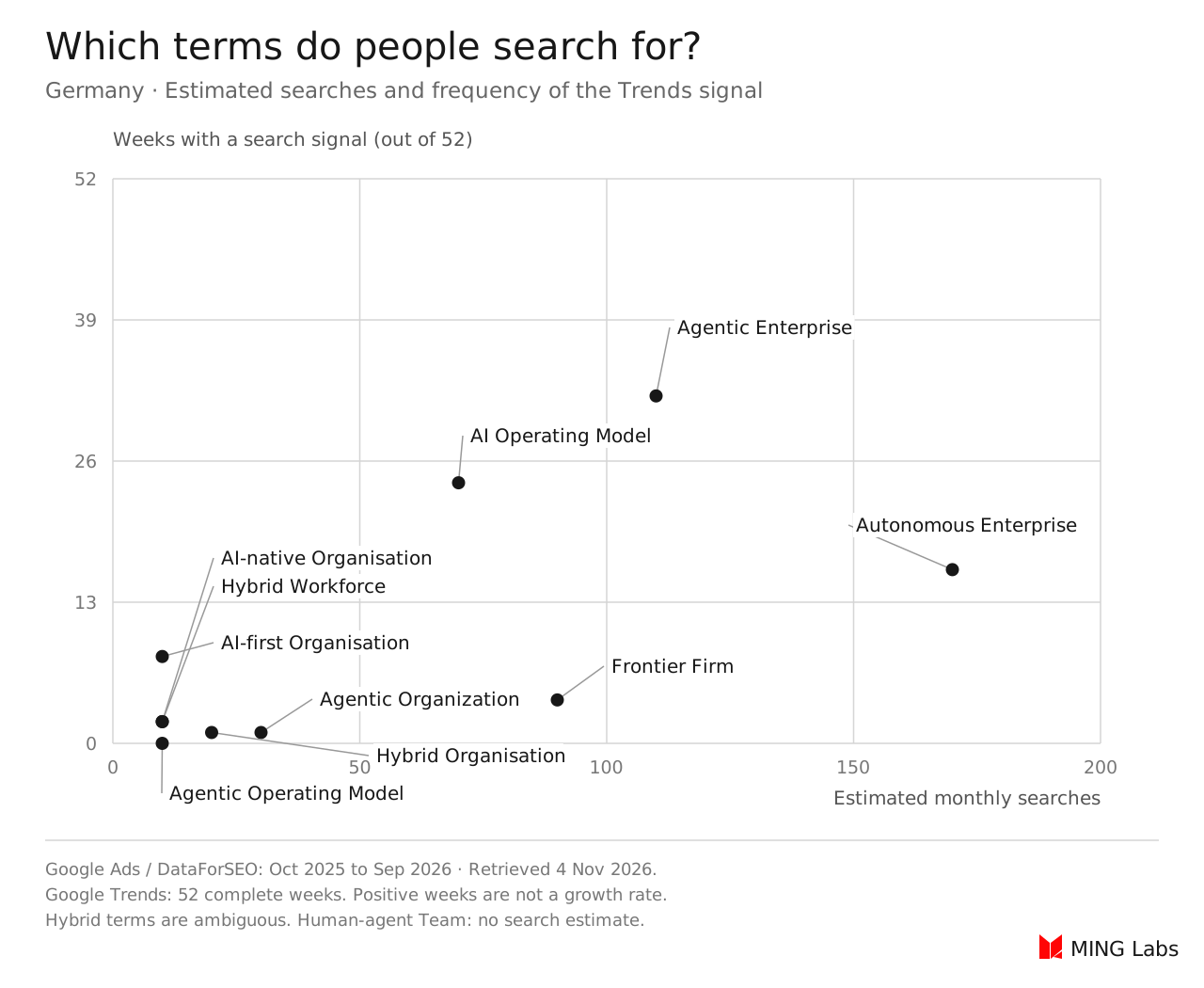
All search values and eleven terms with their sources
Which words the selected texts use
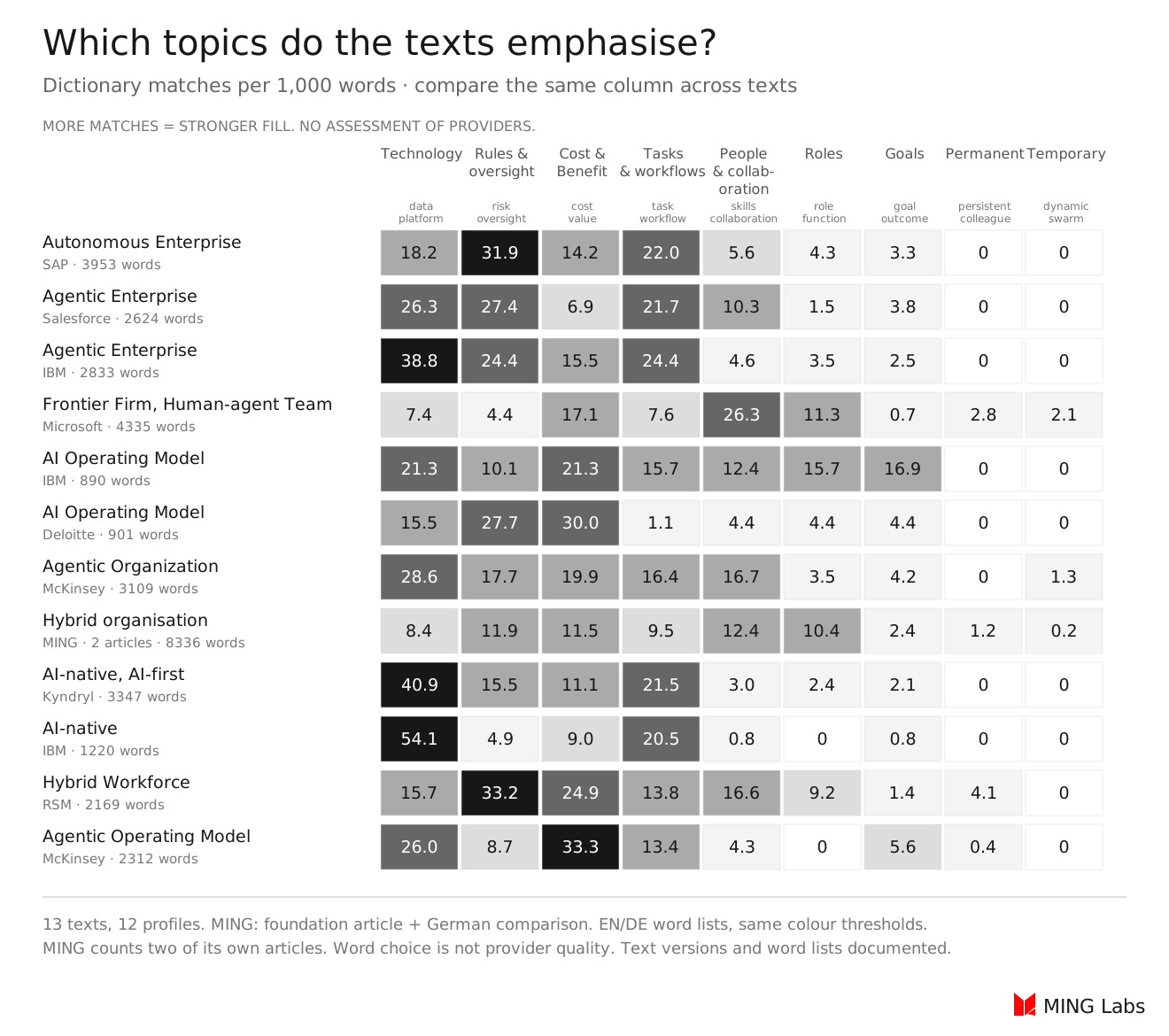
The word matrix shows matches from thematic word lists per 1,000 words. For MING, we count the English foundation article on the hybrid organisation and the German version of this comparison together. The German text is counted using corresponding German search patterns. The MING row therefore covers two articles; the other eleven text profiles remain unchanged. Sources, retrieval dates, word lists and individual counts are linked in the methods section. The word matrix neither tests nor confirms our interpretation of the emphases. We compare word choice, not capability. Language, length and text type differ. A frequent word can have different meanings, and a missing word does not mean a topic is absent.
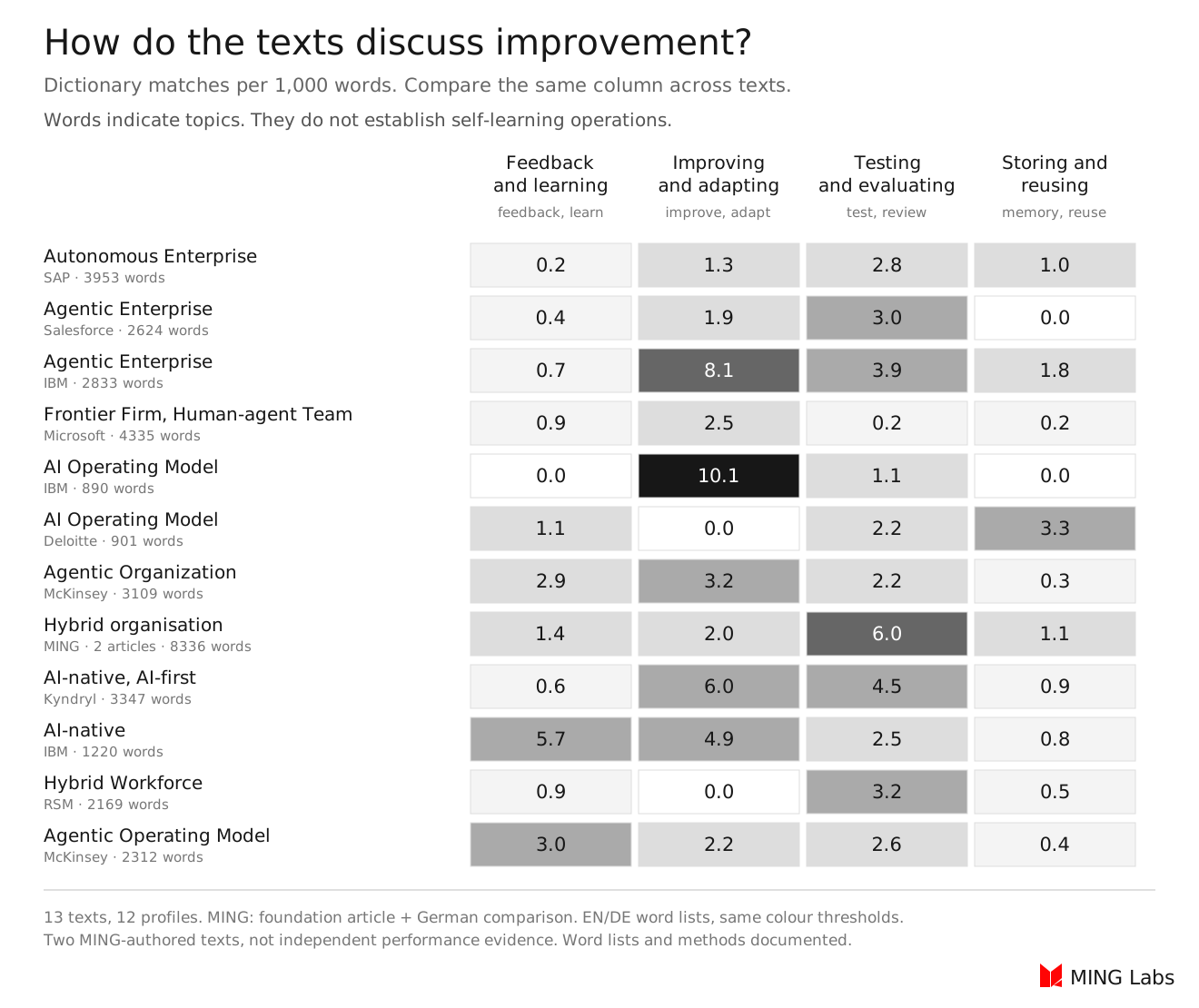
How the texts discuss learning and improvement
The second word matrix counts terms related to feedback, improvement, checking and reuse. These matches also serve as pointers for reading. They do not establish that a provider has implemented a self-learning organisation.
What matters regardless of the name
The common ground is easier to recognise than sharp boundaries. Agentic Enterprise, Frontier Firm, Agentic Organization and hybrid organisation describe a shared direction of development from different perspectives. Time will tell which term prevails. We hope this interpretation brings greater clarity and a calmer, shared basis for discussion.
For companies, what matters now is what this development makes possible in business: doing more, responding faster and economically handling work that remains undone today. Agents must take on suitable tasks, be integrated into teams and systems, and work towards verifiable results. Starting builds operating experience: knowledge of tasks, exceptions and collaboration that makes the next deployment easier. That holds regardless of what we call the organisation.
MING supports you from the first useful agent role to collaboration across entire functions and departments. We clarify the business value with you, build the agents, connect them to your systems and onboard them with your teams. Bring an area where capacity is lacking or work remains undone. Together, we turn it into a concrete starting point with clear tasks, accountability and a testable calculation for setup and operation.
Sources and methods for checking the comparison
The word count covers 13 selected texts in twelve profiles. For MING, we combine the saved English foundation article with the title, subtitle, headings and main text of this German comparison, including link labels and the final method links. The English translation is not counted again. Captions, the CTA and this methods section are outside the counted main text. The other provider profiles are unchanged from the first comparison.
Matches per 1,000 words = counted matches divided by word count, multiplied by 1,000. MING combines the matches and words of both texts. The table below shows raw counts. Longer texts therefore receive no automatic advantage. German patterns are semantic counterparts, not a validated cross-language measurement. More than one group can match the same word.
The comparison counts itself, including passages about other providers and the method. The MING row is therefore not independent evidence of MING’s capabilities. Source and dictionary choices affect the result; colour thresholds are identical across rows. The Microsoft publication from May 2026 discussed in the article is an additional source. The frozen Microsoft word profile uses the 2025 Work Trend Index.
Counted MING corpus: 5466 English words + 2870 German words = 8336 words. Text version: 9 November 2026. All counts, sources and complete word lists as JSON.
The original source URLs, word lists and aggregate counts are public. Saved full-text snapshots are not redistributed; current source pages may differ from them. The matrices document word choice in this selection and do not confirm our interpretation.
| Text and words | Technology | Rules | Benefit | Tasks | People | Roles | Goals | Permanent | Temporary |
|---|---|---|---|---|---|---|---|---|---|
| Microsoft: Frontier Firm, Human-agent Team 4335 words | 32 | 19 | 74 | 33 | 114 | 49 | 3 | 12 | 9 |
| RSM: Hybrid Workforce 2169 words | 34 | 72 | 54 | 30 | 36 | 20 | 3 | 9 | 0 |
| Salesforce: Agentic Enterprise 2624 words | 69 | 72 | 18 | 57 | 27 | 4 | 10 | 0 | 0 |
| IBM: Agentic Enterprise 2833 words | 110 | 69 | 44 | 69 | 13 | 10 | 7 | 0 | 0 |
| McKinsey: Agentic Organization 3109 words | 89 | 55 | 62 | 51 | 52 | 11 | 13 | 0 | 4 |
| SAP: Autonomous Enterprise 3953 words | 72 | 126 | 56 | 87 | 22 | 17 | 13 | 0 | 0 |
| MING · 2 articles: Hybrid organisation 8336 words | 70 | 99 | 96 | 79 | 103 | 87 | 20 | 10 | 2 |
| IBM: AI Operating Model 890 words | 19 | 9 | 19 | 14 | 11 | 14 | 15 | 0 | 0 |
| Deloitte: AI Operating Model 901 words | 14 | 25 | 27 | 1 | 4 | 4 | 4 | 0 | 0 |
| McKinsey: Agentic Operating Model 2312 words | 60 | 20 | 77 | 31 | 10 | 0 | 13 | 1 | 0 |
| Kyndryl: AI-native, AI-first 3347 words | 137 | 52 | 37 | 72 | 10 | 8 | 7 | 0 | 0 |
| IBM: AI-native 1220 words | 66 | 6 | 11 | 25 | 1 | 0 | 1 | 0 | 0 |
| Text | Learning | Improving | Checking | Reusing |
|---|---|---|---|---|
| Microsoft: Frontier Firm, Human-agent Team | 4 | 11 | 1 | 1 |
| RSM: Hybrid Workforce | 2 | 0 | 7 | 1 |
| Salesforce: Agentic Enterprise | 1 | 5 | 8 | 0 |
| IBM: Agentic Enterprise | 2 | 23 | 11 | 5 |
| McKinsey: Agentic Organization | 9 | 10 | 7 | 1 |
| SAP: Autonomous Enterprise | 1 | 5 | 11 | 4 |
| MING · 2 articles: Hybrid organisation | 12 | 17 | 50 | 9 |
| IBM: AI Operating Model | 0 | 9 | 1 | 0 |
| Deloitte: AI Operating Model | 1 | 0 | 2 | 3 |
| McKinsey: Agentic Operating Model | 7 | 5 | 6 | 1 |
| Kyndryl: AI-native, AI-first | 2 | 20 | 15 | 3 |
| IBM: AI-native | 7 | 6 | 3 | 1 |
Search estimates and their limits
Retrieved on 4 November 2026. Google Ads estimates via DataForSEO: October 2025 to September 2026. Google Trends: 52 complete weeks from 2 November 2025 to 31 October 2026 (last recorded week starts on 25 October). The incomplete week starting on 1 November 2026 is excluded. We count weeks with a positive signal for the same query and region. This measures neither growth nor the share of companies using agents. Hybrid terms have other meanings. Missing values do not mean zero demand.
| Query | DE / month | US / month | DE / 52 weeks | US / 52 weeks |
|---|---|---|---|---|
| autonomous enterprise | 170 | 140 | 16 | 52 |
| agentic enterprise | 110 | 480 | 32 | 52 |
| frontier firm | 90 | 260 | 4 | 51 |
| ai operating model | 70 | 110 | 24 | 52 |
| agentic organization | 30 | 40 | 1 | 36 |
| hybrid organisation | 20 | 70 | 1 | 4 |
| ai native organization | 10 | 40 | 2 | 20 |
| ai first organization | 10 | 20 | 8 | 51 |
| hybrid workforce | 10 | 90 | 2 | 52 |
| agentic operating model | 10 | 20 | 0 | 10 |
| human agent team | Not recorded | Not recorded | 1 | 35 |

